


Once the beating heart of the Cremona countryside with nearly 200 inhabitants, Cascina Bredalunga seemed destined for oblivion after half a century of abandonment. Today, two young siblings, Matteo and Letizia, have chosen to restore it to its former glory, transforming a crumbling legacy into a project of rebirth.
Nestled in the countryside of Sesto ed Uniti, the cascina carries a history that begins in the sixteenth century and spans centuries of rural life until the depopulation of the 1970s. Its courtyard still bears witness to time gone by, with walls scarred by machine-gun fire and inscriptions praising cycling legends Coppi and Bartali. Here, the present slowly fades into the past, guarding the traces of a story that belongs to many families of Cremona and the Po Valley.
A cascina is a traditional type of rural building complex found mainly in northern Italy, especially in the regions of Lombardy and Piedmont. It typically refers to a farmstead or agricultural courtyard made up of several buildings organized around a central open space.
The central courtyard of a cascina was more than just an open space that provided protection, made farm work easier to manage, and fostered a sense of community among those who lived and worked there. Historically, cascine functioned as self-sufficient micro-villages, where agricultural workers lived under the guidance of a landlord or landowning family. Within their walls you would typically find farmers’ living quarters, stables and barns for livestock, storehouses for grain and tools, and in some cases even a small chapel.
The first step in the estate’s renewal was the restoration of its chapel. Once the last building in use, it had been abandoned, stripped of its furnishings, and left partially in ruins—yet it endured through time. Its restoration has reconnected a circle of memory that was once broken. Years ago, the statue of the Virgin Mary was saved and moved to the church of Casanova del Morbasco. Today, thanks to artist Giorgio Pastorelli, the chapel has been brought back to life and once again stands as a symbol of rebirth for the entire cascina.
With patience and passion, Matteo, Letizia, and their parents Paola and Felice began the work of recovery: clearing, safeguarding, and welcoming the community back inside the cascina. To better understand the motivations behind this commitment and the vision for the future, we asked Matteo a few questions.

Matteo & Letizia
From the late sixteenth century until the 1970s, Cascina Bredalunga was a centre of community life and agricultural work. After fifty years of neglect, it is now experiencing a new season thanks to your family’s efforts. Matteo, how did the cascina come to you?
Bredalunga represents what was left to us by our grandfather, and so it carries a great symbolic and emotional value, which in turn gives us a strong sense of responsibility and commitment to leave it a little better than we found it. Historically, this cascina belonged to distant elderly relatives, hardworking people who, having no family continuity, gradually abandoned it.

Cascina Bredalunga - 1970
Many would see such a large, ruined place as an insurmountable burden. What convinced you to take on this challenge? Was it a matter of family memory, community ties, or something else?
The first time I set foot in Bredalunga, about 5 years ago, I burst into tears, something that doesn’t happen often. The first question that came to mind was: what did we do wrong to inherit such a neglected and mistreated place, abandoned by everyone? Before then, I didn’t know the cascina well, apart from glimpsing it from the road: its size and architecture can’t go unnoticed.
At that moment, we had two options: close the gate, get rid of it, and forget about it, or try to make our way through the forest and at least see what was inside. I think what drove us was a sense of responsibility, a duty to preserve what had been handed down to us.
As we started pulling weeds, patching collapsed bricks, and cleaning the ditches of rubbish, we came into contact with the community of Sesto and neighbouring villages: people walking or cycling past, who would stop and ask with a mix of curiosity and affection what was happening. I remember Mr. Giancarlo, who became a friend, stopped by with his pup to give us words of encouragement; also Ambrogio, Antonella, and many others who were incredibly supportive. In those moments we began to feel the connection between Bredalunga and the community.
Later, during a regional cycling race that passed through the cascina, a team of volunteers from Sesto helped us make the avenue passable and straighten the crooked, jammed gate; that’s when I realised we were not alone in this challenge, and that there was potential for a new start.
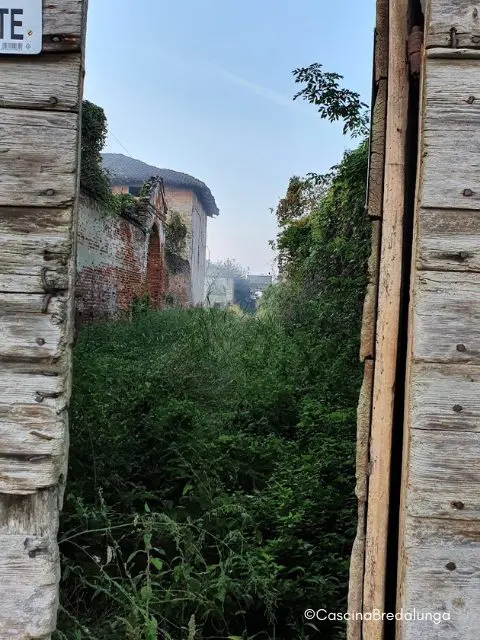
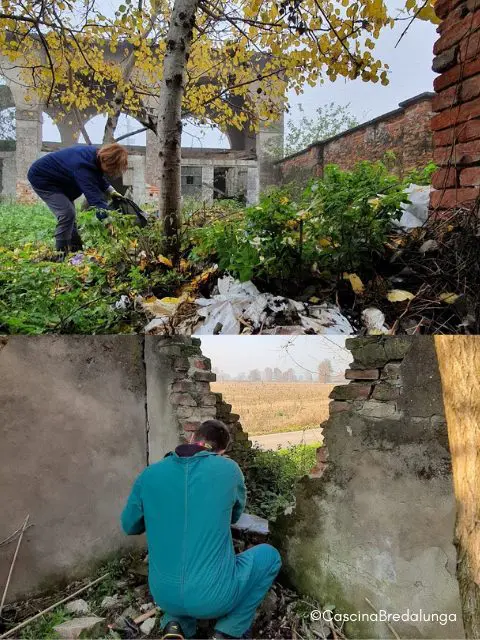
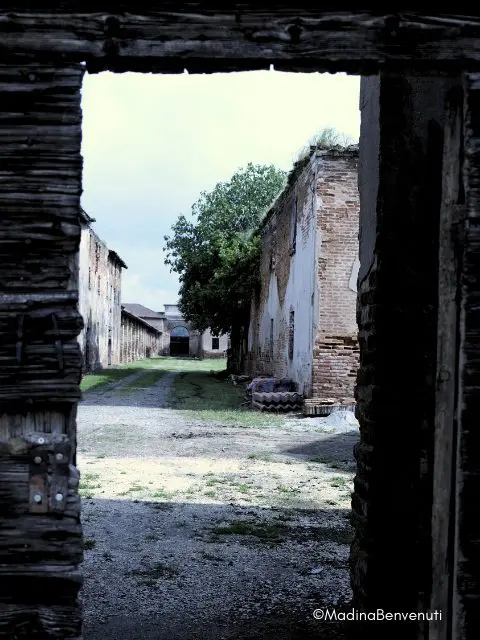
Clearing out the abandoned cascina
A project this ambitious requires time, resources and expertise. What is your vision for the restoration, and how do you plan to sustain it? What are your priorities today: funding, permits, partnerships?
So far, we’ve tried to approach Bredalunga as a steep climb, but to be tackled step by step, within our means, carefully evaluating what we can and should do at each stage. We are fully aware of its immensity, the task at hand of restoring it all in a short time. Personally, I see Bredalunga as virtually divided into distinct areas, each dedicated to a specific but complementary activity, all in harmony with the site and its agricultural character. Each area will need to shoulder a part of the cascina, making the overall restoration sustainable. We would love to start with the events space, and we are looking for partnerships, while welcoming and exploring new ideas.
We have been approached with many different ideas and partnerships however we haven’t come across those that fully contribute to the unique characteristics of the cascina.
What role has craftsmanship and professional expertise played so far? Have you involved architects or specialists in rural restoration?
There are excellent professionals capable of restoring these historic structures. We started from a very delicate situation: the roof of the little church had mostly collapsed and was pressing down on the vaulted ceiling beneath, with water damage and a risk of total collapse. The professionals who intervened worked admirably, almost like the craftsmen of the past, restoring bricks, beams, and historical tiles. They salvaged a roof tile dated 1840, likely from the last roof restoration of that time.
Why did you decide to begin with the restoration of the little church? What treasures does it hold, and what does it mean to you and the community?
The little church is a unique and defining feature of the cascina, and for the community it holds deep emotional value: many grandparents, parents and relatives were baptised or married there. It was a place of prayer and gathering, and people recall that on Sundays the church could not hold everyone, with many waiting outside in line.
With the roof on the verge of collapse, it only had a few months left: we could not allow it to fall. Then came the encounter with Giorgio, something truly indescribable. He fully understood our bond and our feelings, embraced them as his own, and chose to give his art and talent. Today the little church has become once again something unique, preserving a part of the history and culture of all of us.

The restored little church
Looking to the future, what activities do you imagine hosting at Bredalunga?
We would like Bredalunga to once again become a place for people, where one can find serenity and safety while breathing in the history of the agricultural tradition. On the one hand, the cascina can be seen as a true museum of rural life. On the other, looking to the future, we hope to use the reclaimed spaces for socio-cultural events such as presentations, exhibitions and open days, where values and history can also be passed on to new generations.
Among the initiatives already underway is the Bredalunga Motor Show. How did it come about, and what spirit drives the event?
The event was born from encounters with people such as the friends behind the vintage car race Campagne e Cascine, Emanuele from the automotive page RoadCar, and Diego from Scuderia Grassi, together with my own passion for cars and motors. The aim was to bring together different generations and enthusiasts within Bredalunga and to promote a territory rich in people and activities that long to be more vibrant. The initiative was very well received, and we are determined to propose it again, each time with new features and improvements.

Finally, you’ve launched a search to reconnect with former inhabitants of Bredalunga and collect their testimonies. Why did you choose this path, and what has it given back to you?
This search was born out of curiosity and the desire to learn as much as possible about the history of Bredalunga, both to make up for the absence of written and archival sources and to leave a record for anyone who, even decades from now, may wish to explore the origins of the land’s traditions or their ancestors.
I cannot deny that listening to the long-standing residents of Bredalunga recount their lives within these very walls was an indescribable experience: stories of childhood, work and sacrifice, but also of joy, generosity, altruism and sharing. These accounts also help us appreciate the meaning of every single structure within the cascina, revealing why certain shapes, layouts and spaces exist. Everything had a purpose, carefully designed to be practical, efficient and liveable.
Today we know much more about the cascina, its features, and we are more aware of how significant and rich in history it truly is. The testimonies of Bredalunga’s inhabitants were collected by Michela Garatti, who on several occasions has devoted herself with great dedication to researching the history and rebirth of the cascina, making them available to everyone online through Cremonasera and YouTube. We are deeply grateful to Michela, as she was the first to take an interest in Bredalunga’s story, to embrace our spirit, and to give us invaluable help in reconstructing many elements of the cascina’s past.
In conclusion, we too have taken Bredalunga to heart and are fascinated by its history and structure. Yet the most beautiful and unexpected part of this journey has been the support of people who, each in their own way, have contributed to our progress. For this, we sincerely thank everyone for the enthusiasm and encouragement that continue to accompany us.
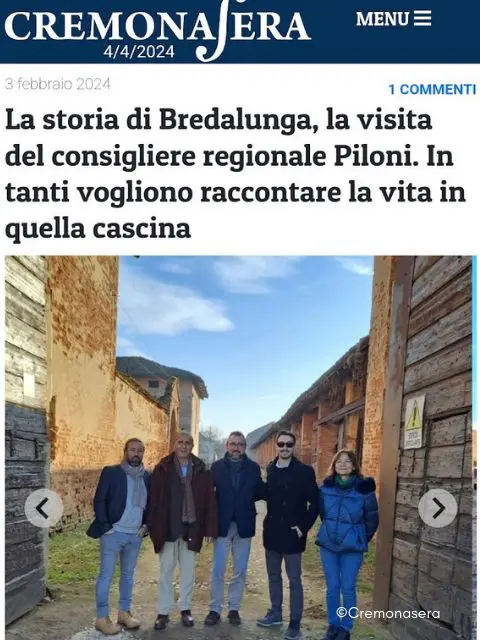
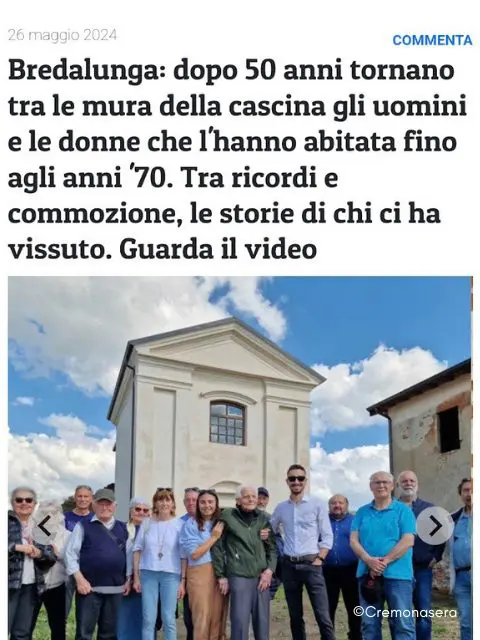
Bredalunga and Cremonasera
This year, the European Heritage Days are dedicated to the theme “Windows to the Past, Doors to the Future.” Why is it important to bring rural architecture like Bredalunga back to life?
The art of making, of building, and also of rebuilding remains vitally important today: it is what preserves the extraordinary architectural and cultural heritage of our land. We care deeply about restoring dignity to the world we come from, but we also aim to bring small improvements and offer a positive example in the face of the neglect and decay that so often surround us.
We draw inspiration from a well-known saying: “Be the change you want to see in the world.” We are convinced that if each of us were to contribute even a small gesture, our land would benefit enormously. Sometimes it takes very little: picking up a piece of litter, repairing a wall, tidying the space in front of one’s home, or pulling up a weed.


