Isabelle Azaïs, “Working with what’s close at hand and ready to use”
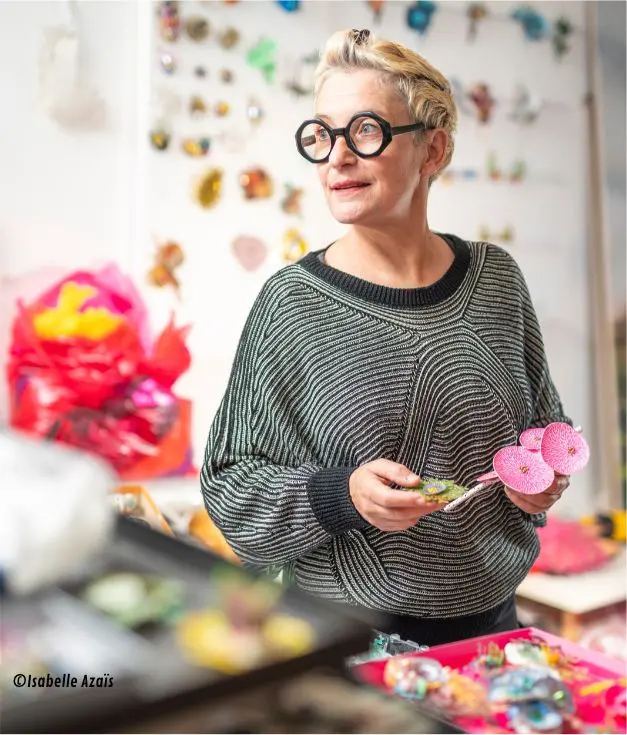
Isabelle Azaïs is a Brussels-based painter and jeweller who describes herself as an “ennobler” of plastic waste. For our newsletter on creativity, she tells us what inspired her to turn packaging into jewellery.
At New York’s Museum of Arts and Design (MAD), several visitors stop at Isabelle Azaïs’s stand. They come closer, look at her jewellery and tell her how beautiful they find it. Only then does she reveal what it’s made of. Isabelle likes it to happen in that order. “It has to charm you first. Recycling is the icing on the cake.”
That was in 2024. Isabelle represented Belgium at MAD About Jewelry in New York and at Schmuck in Munich, two major events in contemporary jewellery. Although still little known to the wider public, contemporary jewellery has been a lively creative field for several decades. It is showcased around the world through jewellery weeks in cities such as London, Barcelona, Porto, Athens, Paris and New York. The next Brussels edition will take place in autumn 2027.
Plastic was everywhere, it was free [...]. It had what she calls a “poisonous beauty”.
How she discovered plastic
Born in the south of France, Isabelle studied fine art in Toulouse before earning a master’s degree in Nantes. She was working as a painter when she and a group of artists moved into a former handbag factory. There were still stocks of leather left inside. “I thought, now what could we do with that?” In 2005, she began making jewellery from it while continuing to paint.
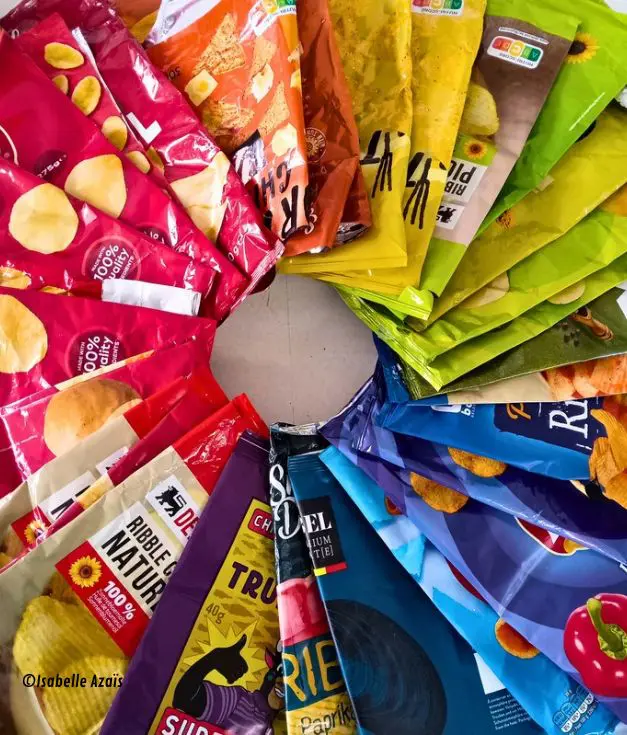
About ten years later, she felt she had explored all she could with leather. She took another look at what she had to hand. Plastic was everywhere, it was free, and she was drawn to its colours. It had what she calls a “poisonous beauty”, like red mushrooms with white spots. That mix of fascination and wariness made her want to work with it.
In 2017, she began experimenting with plastic packaging. In the studio, she kept using the tools and methods she had made her own while working with leather. She also tried new techniques, including lamination, which allowed her to turn thin plastic films into a stronger, more rigid material. With no formal training in jewellery making when she started, she learned by experimenting. Sometimes ideas were slow to come. At other times they came in bursts, like bright, colourful fireworks.
Travelling without leaving home
When we travel, we notice the shape of a cup, a door handle, the curve of a window. At home, these details are easier to miss. Isabelle tries to bring that same attention to the streets she knows. “You can have adventures close to home, as long as you look closely.”
That’s also how she finds her raw materials. She has long practised urban gleaning, picking up discarded materials on the street, and says the habit has grown stronger over the years. When you keep bringing home things that might come in handy one day, you also have to know when to stop. “Free things can come at a price.”
"Value lies in a ‘no man’s land’ of subjectivity. Like an alchemist, I try to make precious things by transmuting base materials."
What gives jewellery its value
Isabelle explains what jewellery means to her. “I can’t use diamonds or gold. I can’t afford them. What I’m after is the chance to experiment with unusual materials. I’m not helping create a treasure of the kind that gets looted in wartime. Value lies in a ‘no man’s land’ of subjectivity. Like an alchemist, I try to make precious things by transmuting base materials.”
When younger makers tell her they don’t have enough money for their work, Isabelle suggests looking at what’s already around them, both for places to work and for raw materials. She also encourages them to look at what others are making, then ask themselves what they could do differently by bringing something of their own to it. That’s what she means by “working with what’s close at hand and ready to use”.