For more than four decades, Welsh master thatcher and carpenter Alan Jones has worked with the materials and techniques that have shaped vernacular roofs for generations. In this interview, he reflects on the close relationship between craft, agriculture and landscape, the knowledge embedded in traditional materials, and the challenges of keeping these skills alive. From the transmission of know-how to the role vernacular practices can play in more sustainable ways of building, Alan invites us to look at thatching not simply as a roofing technique, but as part of a much wider relationship between people, resources and place.

Mad’In Europe. Welsh vernacular thatching is representative of Wales’s built heritage. Can you describe this traditional building technique and tell what makes it different from other thatching techniques found across Europe?

Alan. Well, what you’ll find is that years ago, a lot of techniques around Europe were “traditional”. What is used today invariably is water reed (Phragmites australis), which is a modern material in many places, because that particular reed is an aggressive invasive. So it’s in a lot of places today that it would not have been, and you wouldn’t have had the opportunity to use it.
Vernacular thatching uses local materials found within the landscape, including cereal crops, whatever was grown locally, because that’s part of a food-and-shelter crop, linking a symbiotic relationship between a roof and food.
Welsh vernacular thatching is still using traditional materials found within the landscape.
These can include sedge grass (Carex spp.), wheat (Triticum spp.), oats (Avena sativa), marram grass (Ammophila arenaria), heather (Calluna vulgaris), bracken (Pteridium aquilinum), and other marsh grasses found in wetlands where there was no arable land, as well as heather up in the hills.
Vernacular means “of this place”. So, in other words, something found in your landscape, not in the landscape of China and put into a container and shipped halfway across the planet. You would have thatched with locally available materials, even turf, which is sods of grass with the roots on it.
Traditionally in Britain, cereal crops would have been the most predominant thatching material because they’re grown every year for food, and when you’ve knocked the grain out, the by-product is straw. It used to be long-stemmed straw until the 1950s, when the straw varieties were bred to be short. So today we grow the old varieties, referred to as heritage varieties, because the straw stem is long and you can thatch with it.
So that’s been the mainstay of thatching in Wales and Britain, and anywhere else really, Germany with the rye grass.

MIE. Welsh vernacular thatching is listed as a Critically Endangered Craft on the Heritage Crafts Red List. From your perspective, what are the main reasons for this decline, and what would be lost if these skills disappeared?
Alan. Well, long-stemmed cereals can provide shelter and food. Long-stemmed varieties grow well on poor soil. They don’t need petrochemical fertilizers and herbicides and pesticides. For food security in the future, and a crop which can provide covering on eco homes, this knowledge needs to be retained.Water reed is the new kid on the block. It’s quicker to thatch with, so it’s faster, so thatchers earn more money. And so traditional thatching has died, partly for financial reasons and partly because it’s so difficult now to get the correct materials for thatching, particularly the appropriate straw varieties.
We would lose the ability to create a home, and indeed a roof, out of materials found within the landscape. Once you rely on imported material, you’re narrowing down your ecological ability to create something nice, as our ancestors would have, with materials grown around wherever the building was erected.

MIE – You have devoted many years not only to practising traditional thatching but also to teaching it through workshops across the UK and Europe.What are the biggest challenges in passing on these skills to the next generation?
Alan. I cannot honestly say I am encouraged because traditional and sustainable thatching is in decline and I can only teach people traditional and sustainable thatching on site and I can only do that if I find the customer wanting that sort of roof. I teach young people what I can but only if we get a historical and traditional roof to thatch, young people I work with can learn that.
Most people just want a modern thatched roof. They can learn that, but they’re not learning ancient skills. They’re only learning about modern thatching, and the traditional and sustainable thatching roofs are few and far between. So the training opportunities don’t come up every day. So that’s the biggest single obstacle to passing on skills, is having the work that people can learn on.
But as far as me transferring skills, yes, I’m very keen to. But I do have to have the jobs, the historic jobs. Not everybody wants a historic job. They want water reed because it’s cheaper and it’s quicker and they imagine it’s going to last longer.
One of Alan’s recent thatching awareness days, including Dafydd Driver, his former apprentice, fellow teacher and lifelong friend.
Because you can’t learn traditional and sustainable thatching using a water reed roof. There are some similarities, of course, but it’s not the same. It’s like, you know, using asbestos slates instead of slates you quarry from the quarry yourself. They’re very, very different creatures. They both form a waterproof roof, but the quarry that the slate comes from is connected to a whole chain within the community: the people who extract, process and transport the material. The asbestos slates, on the other hand, arrive in a container from whichever country is selling them cheaply.
So without the actual jobs to work on to train people, you’ve got to be on site. It takes years to learn. And so… There’s no simple answer to this. It’s a complicated subject. And I’m happy to teach, but for me to teach somebody to get to the skill level to carry on in my absence, that would require years of training, and therefore years of working on traditional roofs, with the straw and the base coats, which I haven’t mentioned yet.
One of the biggest single differences with Welsh vernacular is the base coats [A base coat, or historic base coat, is an older underlying layer of thatch that remains on the roof while successive new coats are added.] .
This is why I run courses, because it’s just so difficult to get your head round. And I show examples. I’ve got a slideshow. We go into a workshop and explain the differences, so people get it.
In fact, I even mill grain and bake bread, so people can taste the flour milled from the same grain that is used for the roof, so they can see the symbiotic relationship between food and shelter.
So I do my best and, you know, it has been recognised. There are lots of other reasons why Welsh vernacular thatching is different from any other sort of thatching.

MIE: There is also the question of recognition and certification. Is there currently a recognised qualification for thatchers in the UK, and do you think some form of certification based on skills, experience and training with experienced masters would help improve standards?
Alan: Anybody in the UK can go and work with their uncle for two months and then set up a business and call themselves a master thatcher. Anybody can do that. There is no governing body. There’s a lot of bad thatching going on.
I would like to see standards improved, but it’s quite a difficult task, because anybody young coming through today wants to learn to use water reed because it’s quicker and they’re going to earn more money. So trying to find somebody who’s interested in historic and traditional methods, materials and techniques is very hard work. And so I teach and I explain the differences between traditional and sustainable thatching and modern thatching, and their understanding is improved by that.
Of course I would recommend a certification. You would surely guess that from my whole attitude. There is no governing body. There is one, well, “governing body”, but it is a private, for-profit thatching firm called the National Society of Master Thatchers Limited.
I think there was some effort to make an NVQ, which is National Vocational Qualification, NVQ. But because they’re likely to teach modern materials and modern methods, it’s great in one sense, but it doesn’t help traditional and sustainable thatching. So there isn’t anybody. I’m one of the few people who actually teach traditional methods.

IE: You make a clear distinction between traditional vernacular thatching and modern thatching with water reed. Yet water reed is a durable material and, when grown locally, can also be renewable and sustainable. What, in your view, is the fundamental difference?
Alan: What’s happened today is that most, I think 80%, of thatching in the UK today is water reed, which is not a traditional material. Obviously thatchers would say it is, but they can’t prove it because there’s no archaeological evidence. And most of that water reed is from China. Most thatchers would disagree with me. But you see, I’ve studied the subject, and that is my view, Alan’s view.
But, you know, vernacular thatching is just that. They wouldn’t have had water reed to use because it’s an aggressive invasive. Water reed is now in a lot of places it would never have been. And I take it very seriously, and I’m not able to just say, “Oh yeah, water reed’s traditional,” and that’s the end of it, because in my view, and I have to put that in, say, “in my view, Alan’s view”, it’s not a traditional material, because where would you have found the water reed? And yet we were growing cereal crops to feed everyone, so it was pretty obvious that it was cereal crops, and so that’s what we used traditionally.
You know, I don’t mind saying it as it is because of my involvement with experimental archaeology. I think it’s better to be honest rather than making up stories about a material having been used since antiquity, which has not.
Well, if it’s grown locally, then it’s renewable, sustainable. So, I do harvest water reed, and I do work on wetland management with people who want to gather water reeds from wetlands. But you see, a lot of the wetlands I manage have only been there since 1950. And so when you’re looking at Welsh vernacular, well, it’s got nothing to do with water reed. And other places where water reed comes from would be of a similar ilk. How long has the water reed been there?
I don’t use water reeds on museums or historic buildings because it’s a modern material. But technically, I mean, the properties of the material are very good. You can’t put asbestos slates on a traditional building. You know what I mean?
Water reed is a great material to thatch with. It lasts a long time, and it’s easy, and it’s intuitive, and it’s fine. But it’s not historical. Hence I wouldn’t use it in the Welsh vernacular.
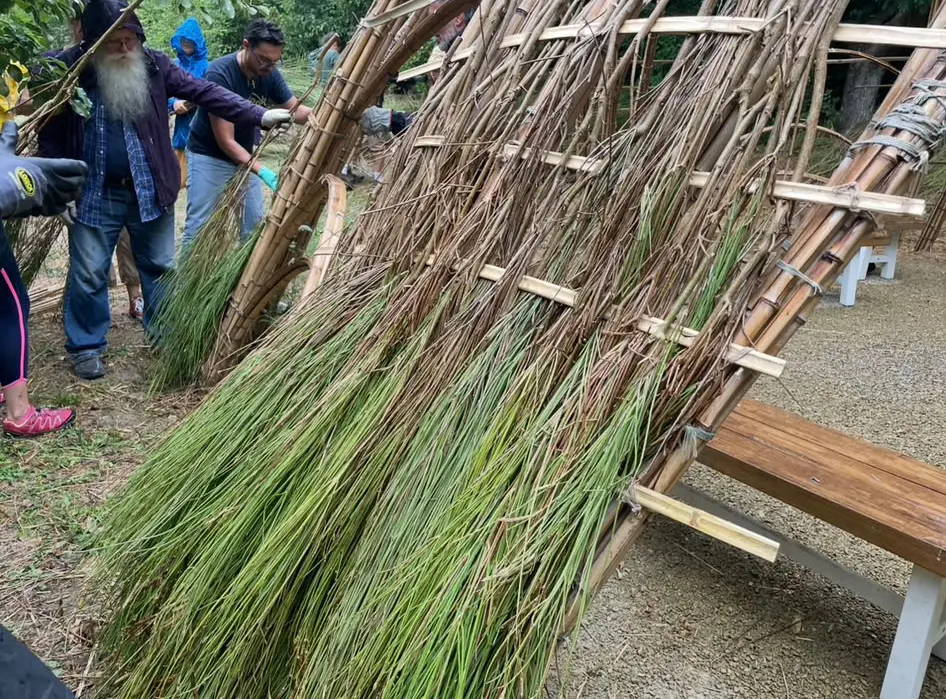
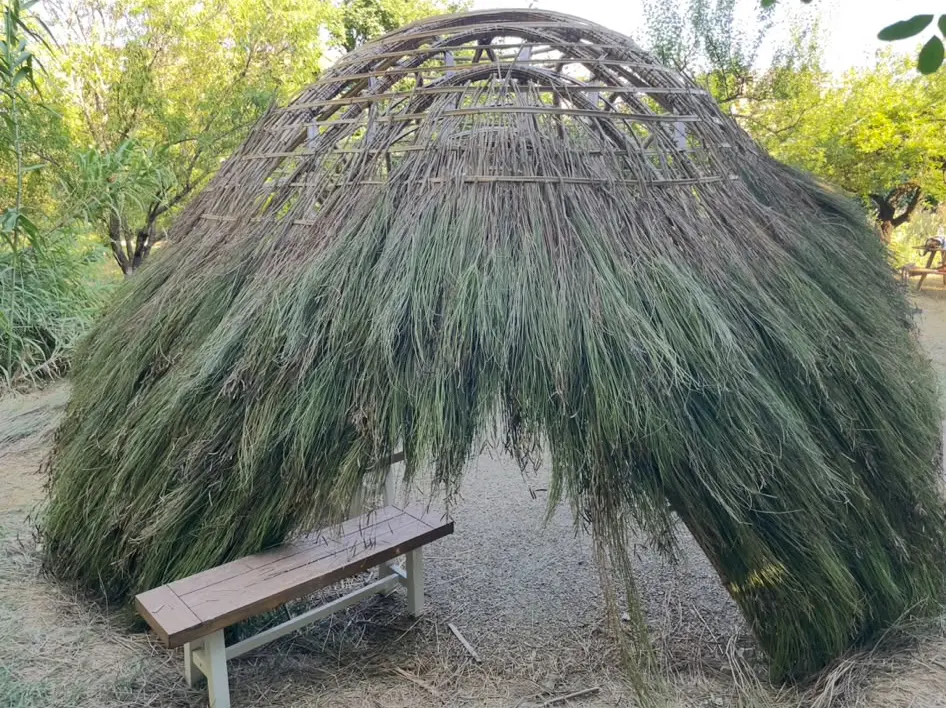
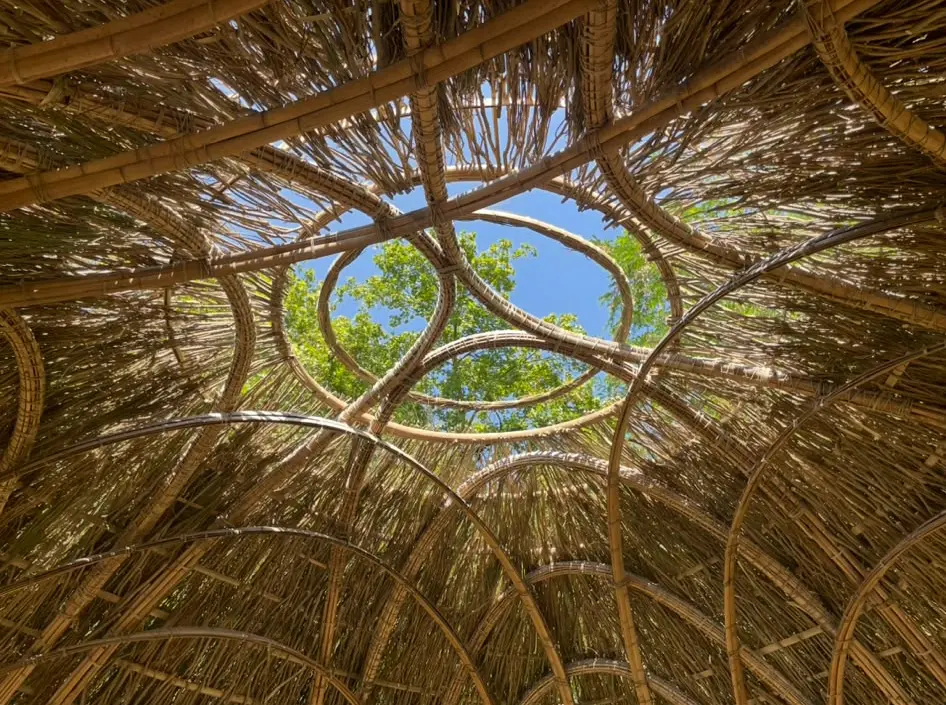
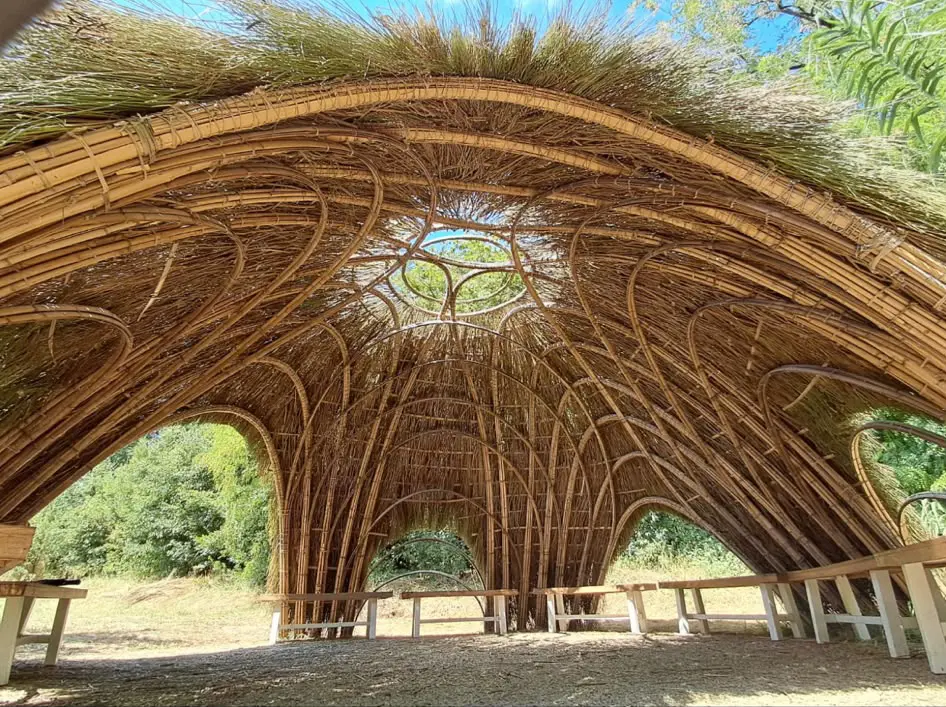
A broom-covered dome at a city farm in Florence, providing a shady classroom for children who come to learn about nature.
MIE: Could adaptation and the use of new materials offer a way forward for vernacular thatching? What role could innovation play in keeping these skills alive?
Alan: I’m a realist. Yes, Welsh vernacular thatching is likely to die out, and it’ll all be replaced with Chinese water reed. I don’t think you have to stop water reed. I think it’s important that people know there is a difference, and they can make an informed decision: do they want to go with the modern material, or do they want to persevere and try and do something more traditional and in keeping with something our ancestors would recognise?.
MIE: Traditionally, thatching was part of a circular agricultural chain: cereals provided food, while the straw became a local, renewable building material. How has the transformation of agriculture affected that relationship and the availability of suitable materials today?
Alan: I agree. Very well put, very well put. Exactly that. That’s right. Well, it was about the 1950s when the long-stem varieties stopped being grown. With the advent of combine harvesters and fertilizers, traditional farming methods went into decline, and agribusiness took over. Agriculture changed, and so it is getting more difficult to find the old varieties harvested in the old ways that create straw which is suitable for thatching.

We can’t even supply enough straw to supply demand now, because there aren’t people growing the old varieties and harvesting them in an appropriate manner. And so, we are obliged to use water reed.
But me being old school, I just do make the difference, so people realise that we are losing heritage and we’re replacing it with a convenient imported material, which doesn’t really fit with historic buildings, you know, because this isn’t the story of humans. This is a story of commerce, you know.
The people who grew the straw, they grew in the communities, so any revenue created was kept within the communities and the knowledge was kept alive in the communities.
And, you know, we’ve only got to get expensive fuel bills, which is happening, and then suddenly this imported material will go up in price, making it more important to learn how to be self-sustainable.
MIE: What role do you think thatching can play in shaping a more sustainable future for the built environment? If you could change things, what would you like to see?
Alan: Well, long-stemmed cereals can provide shelter and food. Long-stemmed varieties grow well on poor soil. They don’t need petrochemical fertilizers and herbicides and pesticides. For food security in the future, and a crop which can provide covering on eco homes, this knowledge needs to be retained.