
 Alessandro Bianchi
 Italy
Italy

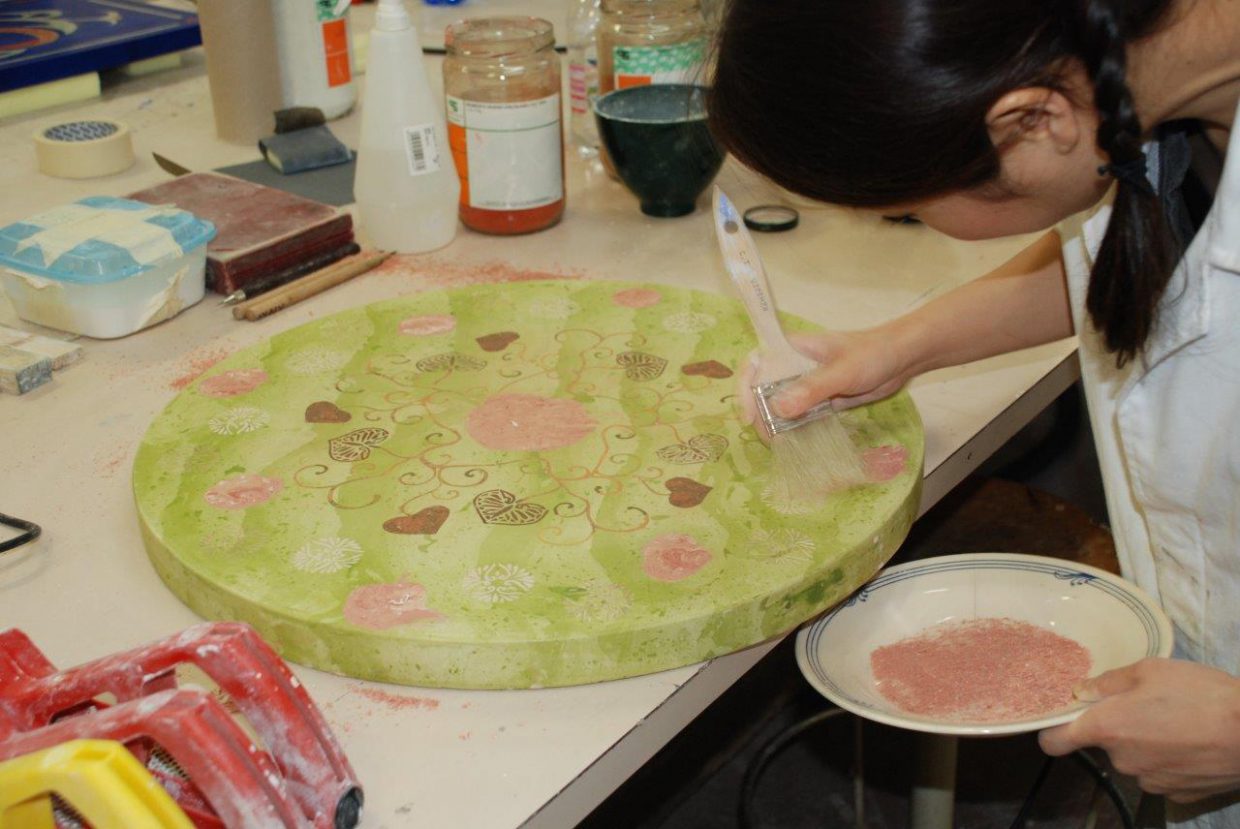
‘A little bit of chaos and a lot of passion’ is Leonardo Bianchi’s motto to live by.
As a third generation of scagliola master-in-the-making, Leonardo insists that he is still learning; learning from his father, Alessandro Bianchi, and his aunt, Elisabetta Bianchi, keeping a legacy alive. The legacy of his grandfather, Bianco Bianchi, who took a timeless craft technique and made it the family’s own.

The art of scagliola spread to Italy in the 16th century, close to the region of Modena. It is described as the art of imitating marble, a material that added a luxurious touch to architecture of the time. The technique uses selenite, a natural form of gypsum abundant in the Apennines of Bologna and Reggio Emilia, mixed with water, glue, and pigments to reproduce the depth and veining of marble in tones that spanned from deep ivory blacks to bright red ochres and yellows.
In the 17th century, the technique was known as Meshia. During that period, scagliola became a favourite method for crafting altar frontals, altarpieces, and ritualistic objects. Its appeal lay in the richness it brought to church interiors, the simplicity and availability of its materials, and its relatively low cost. Scagliola adorned churches both large and small, giving visual form to spirituality, the veneration of the Virgin, and of the saints, through colourful, elaborate images.
Two main crafting methods were documented in the 17th and 18th centuries.
One required transferring a drawing onto the plaster support using the ‘spolvero’ (cartooning) technique: the contours were engraved and filled with coloured scagliola, while the excess plaster was later removed to reveal a black background. The second method began with the support being entirely covered in black scagliola, which served as the background. The design was then carved and filled with the chosen colours.
In both processes, the finished surface was carefully smoothed and polished with walnut or linseed oil, giving the work its characteristic depth and sheen. The technique of scagliola, a delicate and enduring craft, continues to inspire artisans today.
The bottega Bianco Bianchi, founded in post-war Florence, is rooted in this centuries-old tradition. From the first workshop in the 1950s to today’s internationally recognised atelier, its story unites dedication, mastery, and an enduring passion for beauty.
Leonardo’s grandfather, Bianco Bianchi (1920–2006), was a state employee and painter, spent nearly a decade studying the lost art of scagliola. His talent soon reached beyond the boundaries of Europe to major cities in America including Pittsburgh, New York, and St. Louis, earning wide acclaim.
He devoted himself entirely to it, creating, restoring, and archiving works that continue to define the soul of the atelier today.
“The scagliola technique is a field of possibilities through which one can explore their own artistic preferences, all you need is passion.”
Leonardo Bianchi

Incorporating Boetti's style with Scagliola
In the beginning, inlaying was one of the most difficult things, but also one of the most interesting. His muscles were not used to the movements, “I used to feel pain. I had intrusive thoughts that said I will never be good enough or precise. My hands and wrists used to feel hurt. Every time I practiced, I reminded myself that I wasn’t born knowing the technique, I had to learn. To stay curious right until I found peace in the technique.”
Music and poetry accompany him as he works. Rock and roll, punk rock, pop – “I find myself in what I listen to,” he says. Working with a hammer and chisel became a form of calm. “I find it very relaxing,” he explains. “It’s one of my favourite parts of the job, where I focus and everything goes silent.”
Adding to this, safety first. Leonardo always uses glasses and takes the necessary precautions to take care of his eyes, as inlay with a hammer and chisel is also a dangerous task.
He pauses, thinking, “I don’t like when people talk about my work as if it were derived from my inner talent, because I believe in learning. I worked hard to master the skills of scagliola.”

Leonardo Bianchi, now 30 years old, attended the Liceo Scientifico, a scientific high school. He grew up in the workshop alongside his family, surrounded by glues and marble, which instilled in him a strong sense of identity and belonging to his family’s legacy.
He recalls that his school teachers did not understand the importance of craftsmanship and individual passion, which led him to pursue law for a semester, a path that didn’t last long. He stresses, “I was mature enough to understand what my future could be. I understood that I liked arts and music, the world of music, making and restoring old pieces.”
It was a new challenge, with new problems, but learning the techniques started to make him feel relaxed. “This could be my identity,” he says. Leonardo was born into a family of craftsmen, but he doesn’t believe that is why he continues to do what he does. In the workshop, there isn’t a specific role; everyone has to do their own job, give 100% of their time, and perfect every task. He never wanted to be seen as ‘the son of the boss.’ He started from the very beginning, cleaning the floors, washing paintbrushes, and preparing the tabletops where they work, learning to use gypsum.
“If I have a goal,” he adds,“it is to be recognised in the future for what I have learned, mastering the technique well enough, even if only 50%, to be able to carry on this business.”


The archive at Bianco Bianchi
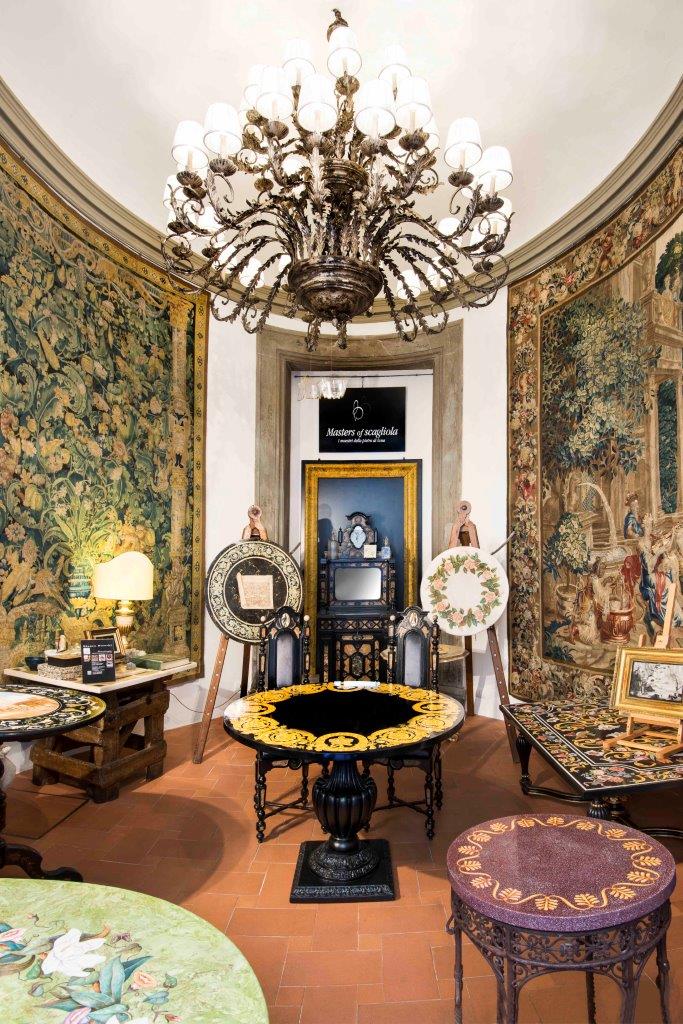
The atelier also holds a collection of pieces starting from the 17th century. It is a place where past and present meet. One can see pieces adorned with classical motifs and ornaments, pieces that are more alive than ever. The scagliola style is where everything begins.
From there, Bianco Bianchi arrives at a point where tradition meets a new world, tailoring their creations for different kinds of customers, past, present, and possible future.
The iconography and colours of scagliola originally belonged to the church and to the aristocracy of Germany and Bavaria. Today, Leonardo seeks to make a bit of chaos, something that belongs to contemporary culture. “I do not want to betray what has been,” he says, “but we can take a point from the past and transform it for the future generations.”
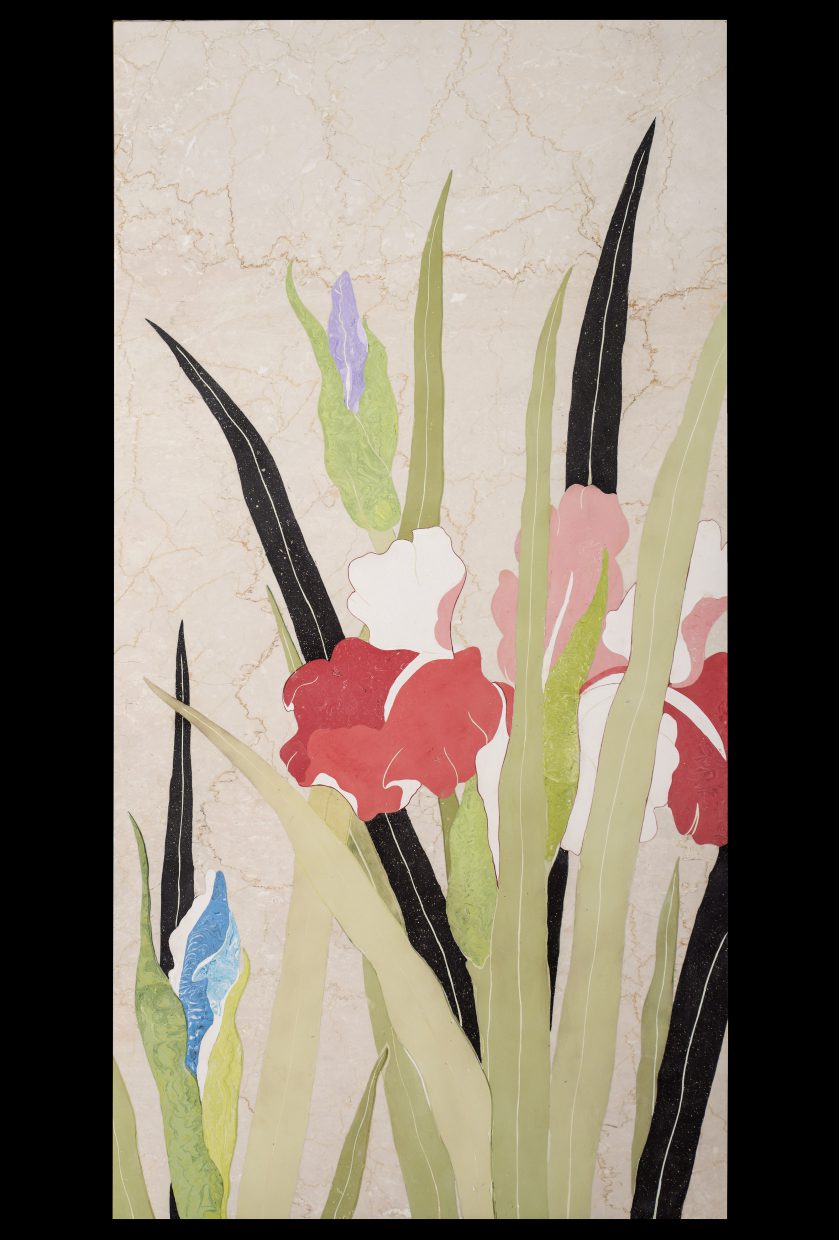
Historically, scagliola has been appreciated by older collectors. “But a guy like me, how would he want a piece of scagliola?” he asks. “Through manga, anime, football, music, we can convey those worlds over marble or slate. Let’s be brave with colours, let’s add a pink, a strong green.”
This balance between tradition and innovation defines the spirit of Bianco Bianchi. “We adapt the subject,” Leonardo explains, “but never the craft’s technique.”

A recent project marked the anniversary of Alighiero Boetti’s death. They created a table top inspired by Boetti’s aesthetic and his idea of tutto – everything. A client who saw the artwork commissioned a piece: a scagliola inlay representing objects that spoke of her family’s passions, an iPhone, a book, a PS5.
For this project, the atelier changed its approach completely, adding Baroque influence, revising iconography, and recreating a beautiful and challenging piece. The process became a dialogue, a work that reflects personality and soul, created together with the client’s children, meant to pass from one generation to the next. “The pieces we are creating are transferred by generation, and our desire is that they can belong to a family forever.”

He recalls, for instance, an old client from Pasadena, a table top made by his grandfather decades ago. “Still magnificent even after sixty or seventy years,” Leonardo smiles. “That person showed us how much he still feels for it, an octagonal table top with classical motifs.”

Bringing his dad into the conversation, Alessandro Bianchi, we learn about the fascination of the workshop through the dialogue between craftsmanship and digital innovation. Alessandro began experimenting with NFTs, exploring how this world could intersect with the realm of restoration and collection. “We are craftsmen, restorers, and collectors,” Alessandro says. “These digital materials are also helpful.” They have launched a new website offering multiple immersive experiences into the world of scagliola, a VR 360-degree view of the bottega, opening the workshop to those who cannot visit in person.
The studio is currently developing interactive exhibitions, translating heavy and fragile objects translated into virtual reality. “We are still discovering this,” Alessandro explains.
Despite embracing new technologies, their goal has always been to remain faithful to the original. Plaster, gypsum, natural colours, oxides, animal glues, even recycled fish glue, all are used with care to avoid chemical additives that could damage the delicate colours of scagliola. Each surface is polished with beeswax or natural lacquer, reflecting a green philosophy that has guided the atelier for the past decade.
Eight years ago, they began working increasingly with slate, creating scagliola panels, columns, walls, and objects as lighter alternatives to marble. “A heavy table top is not easy for anyone,” Leonardo explains. “We use new techniques of thin layers of marble and aluminium to make them easier to move and carry.”
Each piece is designed to last for generations. “Crafts like scagliola hold sustainability deep within its veins. These pieces are done to last forever.”


Yet the mission extends beyond preservation. “My goal is to make this word scagliola, this technique, known to more people. Common people don’t know what scagliola is. I want to make it a topic of conversation among friends, among people of my generation, not popular, but known, within its own status and its own place.”
He is determined to change the narrative: scagliola was never merely a cheaper imitation of marble. “It is an artistic technique with its own independent status, not to be misunderstood or confused with mosaics.”
This belief in passion and freedom is what drives the next generation. During the Artigianato e Palazzo fair in Florence, Bianco Bianchi hosted live demonstrations of the craft. Among the visitors was an 18-year-old from Como, Italy. “He told me he only thought about playing football before,” Leonardo recalls. “I had this small top to show people how the technique worked, and he asked to try. The most important thing is how you move it. I told him to be free, to follow what he feels.”
Scagliola, he explains, offers a field of possibilities. “When I inlay, I feel free. I didn’t feel that way during the horrific semester studying law. Here you can explore yourself, even if you want to draw Mickey Mouse, why not? I failed many times before mastering the technique. But if you like art, cinema, or poetry, there are so many inspirations that can feed this passion.”
That sense of freedom, for Leonardo, is the heart of authenticity. “Later, people will recognise what is genuine and independent. That’s more important than business,” he says. “When you feel free doing something you like, you feel happy, you are pursuing a job and following your passion.”


