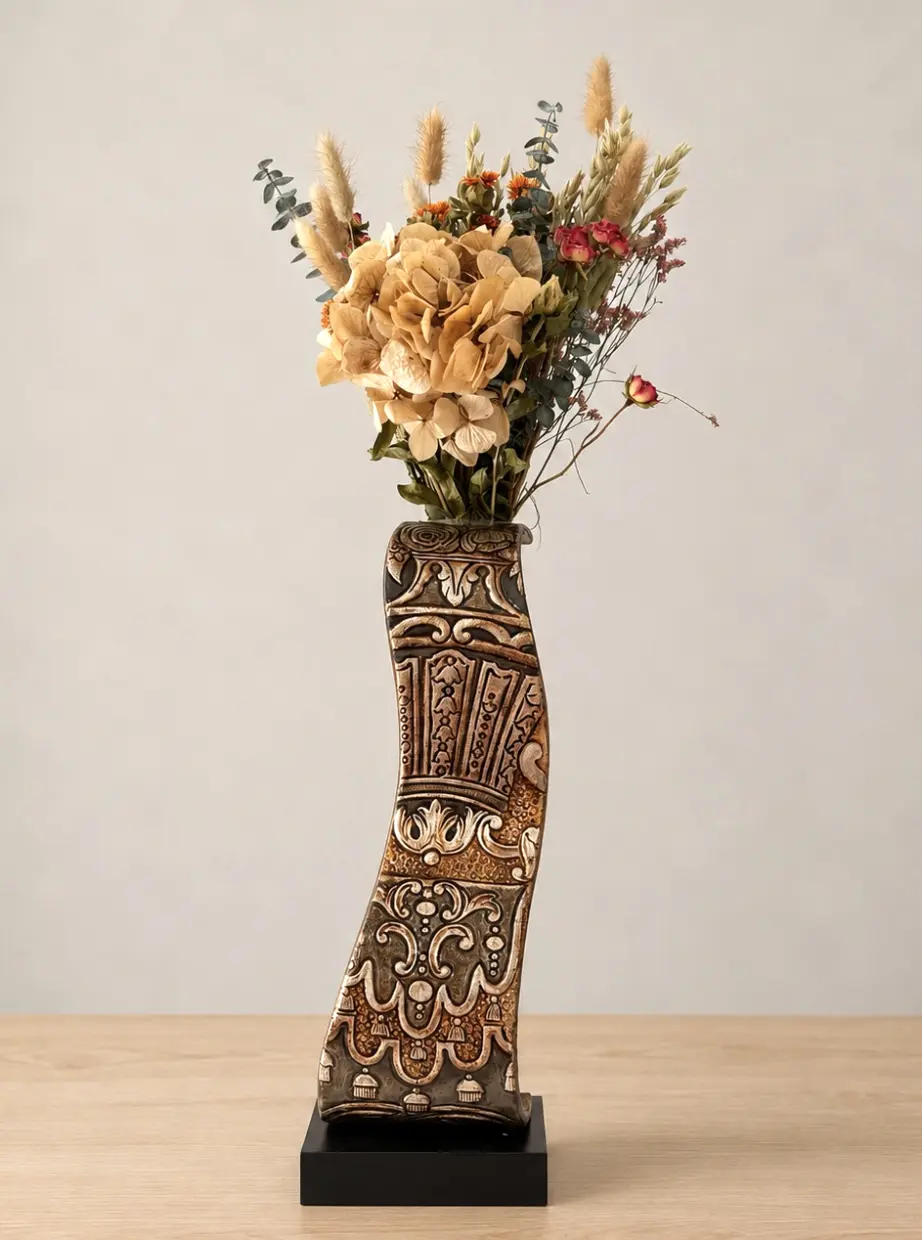
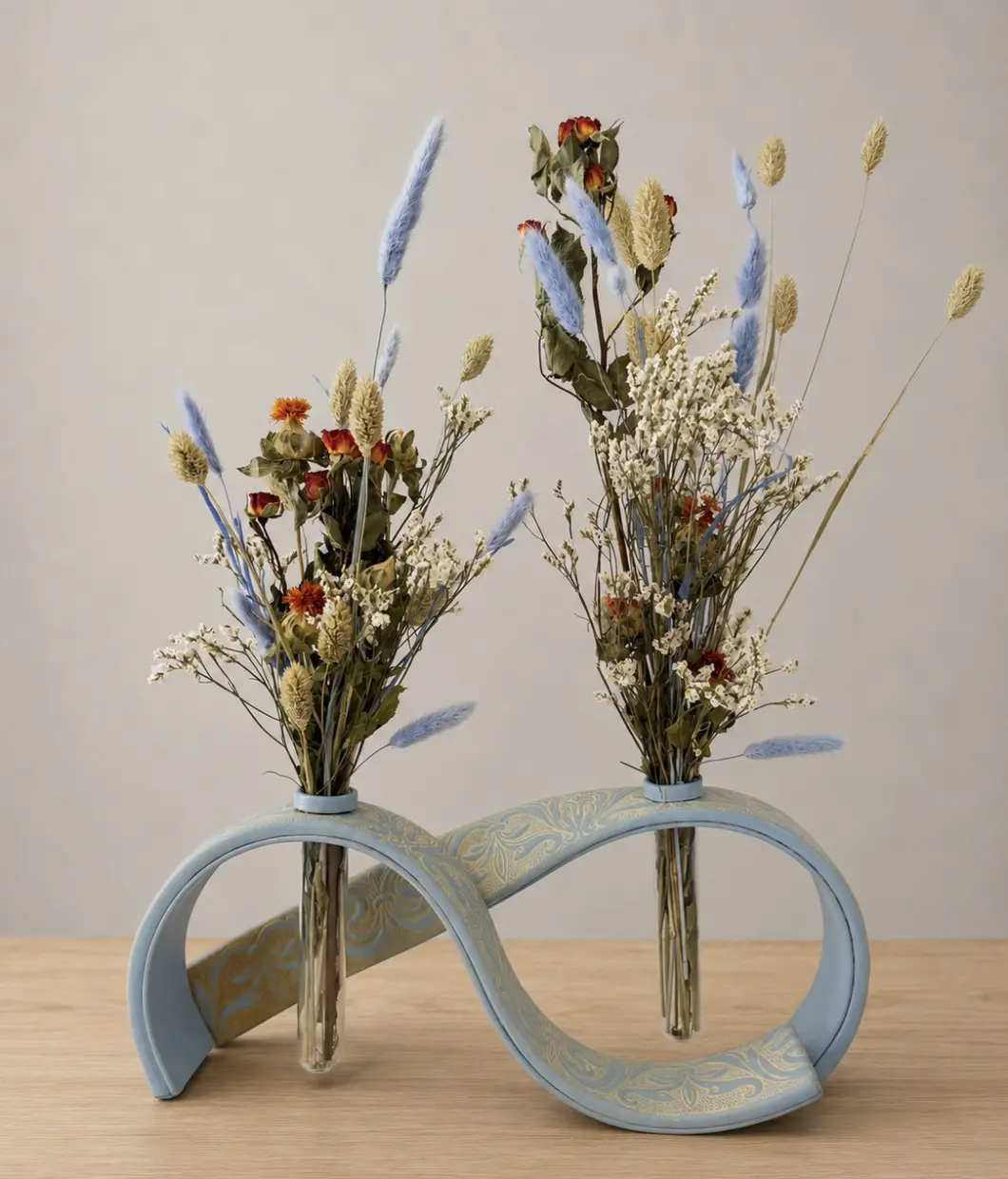
Meryan is a family owned and run shop in the heart of the Southern Spanish city Cordoba. They are exclusively dedicated to the handcrafted products of the traditional Cordobán Leathers, Cordobanes and Guadameciles. The shop is run and owned by two brothers, Alejandro and Carlos López-Obrero who are continuing the traditional craft handed down to them from their parents Angel and Mercedes López-Obrero. The shop began in 1952 and has enjoyed uninterrupted work since its establishment. The name Meryan was derived from the combination of the founders’ names MERcedes Y ANgel giving the shop a unique familiarity and tie to its past. With a team of skilled craftsmen under the constant supervision of Alejandro and Carlos, Meryan produces a vast verity of hand crafted leather goods and prides itself in tailoring its product to its clients and is alway available for custom requests.
Some of the regular product seen at Meryan’s are decorative panels, heraldic coats of arms, genealogical trees, mirror frames, ornamental hangings, chairs, professional emblems, jewelry caskets, national and municipal coat of arms, screens, book covers, large chest, tobacco-boxes, tables, maps and headboards. At Meryan’s they are also happy to assist you with any restoration of deteriorated leather.
Cordovan vs “Guadameci”
Cordovan has a functional character. This can be a decretive piece or not. Cordovan was traditionally applied to a verity of furniture pieces, never possessing the silver or gold leaf. This is because the leafing would be worn away with use. “Guadameci” is always worked with the metal leafing and color, particularly more artistic and ornamental.
The making of Guadamecí also known as Guadamecil
Known as an artistic work over tanned leather, the artisan uses a fine sheet of silver, gold or other metals to prepare the surface for embellishment. The leather used, is most often from rams and sheep. The leather chosen for this process must be in perfect condition, without blemish, to allow for an excellent result. Guadamecí has a purely aesthetic function originally for adorning interior walls, through the years the technique has been applied to adorning furniture and other lightly used pieces for additional decorative options.
This technique is original to the Iberian Peninsula and began under the Arab dominion in Southern Spain. During this time the Arabis introduced much of the elaborated techniques of tanned leather to most of the Peninsula.
The word Guadamací is of Arabic organ from the word Wad’almasir meaning decorated or worked leather. The tradition was deeply rooted in the North African city Ghadamés where in the Medieval times was famous for leatherwork.
In Spain you can find different artistic styles that incorporate geometric patterns and shapes dating back to the XII and XV centuries also from the baroque and neoclassical times. A small handful of examples still exist from the XIV and XV showing clear Arab tradition. In the centuries XVI through XVIII was a thriving time for the Guadamací artisan. Considered an aristocrat in the realm of artisans, Guadamací quickly become a symbol of riches and status. This tradition of leather working was dominant until the end of the XVIII century. The tradition was greatly affected and almost lost from the industrialism of leather. Quality pieces became more scarce and where greatly affected by the importation of a similar technique used in Japan. These Japanese pieces of work became popular do to their similarity to the Guadamací style though where more economic do to their application over paper as a substitute for leather.
The making of Cordobán
Cordobán is tanned leather from male and female goats of great quality. Tanning is achieved with a dye extracted from the Sumac plant family. Over leather, this dye gives a vibrant finish. Other vegetable dyes such as Pine and Holm Oak are used in the cordobán process though may not achieve the same quality as the Sumac. Cordobán may also be embossed and decorated with paints. Cordobán is valued for its great flexibility, resilience and durability which determined its prestige. Traditionally used for functional pieces and can withstand heavier use then Guadamací. Since the Medieval age, Cordobán has been used for the making of trunks, bags, luxurious shoes and gloves.
Leather Working Techniques
Todays techniques have been handed down through the centuries making them essentially the same as was used in the past with the exception of some social influences.
To begin a work, the artist or craftsmen draws a design on paper. This gives the artist the flexibility of transferring the chosen design to the desired piece of leather at a later time. The drawing is considered both the most important and difficult part of the process. The intricacy of the chosen pattern, demands both consistency and accuracy. This drawing is then traced onto onion-skin paper and intern used to re-trace the pattern on the grain side of the leather. The leather must first be properly dampened with water to give it the needed flexibility. To transfer the pattern to the leather, a graver or tracer is used. To proceed, the artist makes a series of incisions with a small knife to cut a shallow groove, which can be opened later in the process. He then creates planes of slightly different depths by pressing the leather on the grained side with a spatula, preparing the leather for the embossing process. Embossing is comprised of making relief-work which protrudes higher then the thickness of the leather. To do this the artist works on both the grain side of the leather as well as the underside. He uses a type of clay and a ball-embosser which allows him, to an extent, sculpt the leather until the desired relief is obtained. Artist then uses a method of work called “Gophering”.
This is closer to a principle of work rather then a technique. To achieve this method the artist uses iron punchers possessing small geometric patterns engraved on the face. These irons leave a shallow impression on the leather smooth leather. In some cases the artist will apply mosaic pattern usually by juxtaposition a classical method of Roman mosaics. This is achieved with fragments of leather placed strategically, giving the design more body and shape. In some cases the leather is left natural or may be colored to give it a greater vibrancy. Monochrome or polychrome may be achieved with several dyes. Such dyes are obtained from chemical solutions such as iron sulphate, potash, caustic soda, picric acid, or walnut-stain, anilines and contemporary alcohol dyes. In some cases oil paints may also be used. Another finishing method that may be used is metallization. This is applied to the surface of the piece. Silver or gold leaf which is adhered to the grain of the leather with a special mixture. This is called “bitting” taking several hours to complete. Burnishing is done and the colors are applied with varnish, oil or wax on the metabolized surface, to obtain the final gloss.
2022
This years we have decorated a hotel in the city of Seville. The work has consisted of lining the walls of a room with guadamecil panels.
We have also collaborated with Christian Dior brand , we have been working in some articles for the brand.
DANIEL LÓPEZ-OBRERO CARMONA PARTICIPÓ CON MAD’IN EUROPE EN LAS JORNADAS DE CREATIVIDAD E INNOVACIÓN
https://youtu.be/BbwineN3mK8
MERYAN
Meryan est une boutique familiale située au cœur de la ville andalouse de Cordoue, dans le sud de l’Espagne. Elle se consacre exclusivement à la fabrication artisanale de produits en cuir traditionnel cordouan, cordouans et guadamecíes. La boutique est dirigée par deux frères, Alejandro et Carlos López-Obrero, qui perpétuent l’artisanat transmis par leurs parents, Ángel et Mercedes López-Obrero. Ouverte en 1952, la boutique a maintenu une activité ininterrompue depuis lors. Le nom “Meryan” provient de la combinaison des prénoms des fondateurs, MERcedes et ÁNgel, conférant à la boutique un lien unique et familial avec son passé. Avec une équipe d’artisans qualifiés sous la supervision constante d’Alejandro et Carlos, Meryan produit une large gamme de produits en cuir faits à la main et s’enorgueillit d’adapter ses créations aux besoins de ses clients, étant toujours disponible pour des commandes personnalisées.
Parmi les produits réguliers de Meryan, on trouve des panneaux décoratifs, des blasons héraldiques, des arbres généalogiques, des cadres de miroirs, des tentures ornementales, des chaises, des emblèmes professionnels, des coffrets à bijoux, des blasons nationaux et municipaux, des paravents, des couvertures de livres, des grandes malles, des boîtes à tabac, des tables, des cartes et des têtes de lit. Meryan propose également des services de restauration de cuir détérioré.
Cordouan vs Guadamecí
Le cordouan a un caractère fonctionnel, décoratif ou non. Traditionnellement appliqué aux meubles sans feuilles d’argent ou d’or, car l’usure aurait enlevé le métal. Le guadamecí, en revanche, utilise toujours des feuilles métalliques et des couleurs, ce qui le rend plus artistique et ornemental.
Fabrication du guadamecí (ou guadamecil)
Le guadamecí est une œuvre d’art réalisée sur du cuir tanné, où l’artisan utilise des feuilles d’argent, d’or ou d’autres métaux pour embellir la surface. Le cuir, généralement de bélier ou de mouton, doit être en parfait état pour obtenir un résultat excellent. Cette technique est originaire de la péninsule ibérique sous la domination arabe dans le sud de l’Espagne, et était à l’origine utilisée pour décorer les murs intérieurs. Avec le temps, elle a été appliquée à des meubles et d’autres objets décoratifs.
Le terme “guadamecí” provient de l’arabe “Wad’al-masir”, qui signifie cuir décoré ou travaillé. Cette tradition est profondément ancrée dans la ville nord-africaine de Gadamés, célèbre pour son travail du cuir au Moyen Âge. En Espagne, on trouve des exemples de cette technique datant des XIIe et XVe siècles, influencés par l’art arabe, baroque et néoclassique. Bien que cette tradition ait prospéré entre les XVIe et XVIIIe siècles, elle a subi un déclin avec l’industrialisation et l’importation de techniques similaires en provenance du Japon.
Fabrication du cordouan
Le cordouan est un cuir tanné de chèvre, mâle ou femelle, de haute qualité. Le tannage est réalisé avec une teinture végétale extraite de la plante du sumac, qui donne une finition vibrante. D’autres teintures végétales comme celles obtenues du pin et du chêne sont également utilisées, bien qu’elles n’atteignent pas la même qualité. Le cordouan est apprécié pour sa flexibilité, sa résistance et sa durabilité, le rendant idéal pour des objets fonctionnels tels que des malles, des sacs, des chaussures de luxe et des gants depuis l’époque médiévale.
Techniques de travail du cuir
Les techniques actuelles ont été transmises au fil des siècles, restant essentiellement les mêmes, à l’exception de quelques influences sociales. Le processus commence par un dessin sur papier, qui est ensuite transféré sur le cuir préalablement humidifié. Le motif est tracé à l’aide d’un burin, et au fur et à mesure du processus, le cuir est ciselé et sculpté, créant un relief. Ensuite, la technique du “gaufrage” est appliquée, et le cuir peut être coloré avec des teintures naturelles ou chimiques. Dans certains cas, une feuille d’or ou d’argent est appliquée pour la finition finale.
En deux mille vingt-deux, nous avons décoré un hôtel dans la ville de Séville en recouvrant les murs d’une salle avec des panneaux de guadamecí. De plus, nous avons collaboré avec la prestigieuse marque Christian Dior pour la création de plusieurs articles exclusifs.
Par ailleurs, Daniel López-Obrero Carmona a participé aux Journées de Créativité et d’Innovation avec Mad’in Europe.
MERYAN
Meryan es una tienda familiar ubicada en el corazón de la ciudad andaluza de Córdoba. Se dedica exclusivamente a la elaboración artesanal de productos tradicionales en cuero cordobán, cordobanes y guadamecíes. El negocio está gestionado por dos hermanos, Alejandro y Carlos López-Obrero, quienes continúan el oficio tradicional transmitido por sus padres, Ángel y Mercedes López-Obrero. La tienda abrió en 1952 y ha mantenido una actividad ininterrumpida desde entonces. El nombre “Meryan” proviene de la combinación de los nombres de sus fundadores, MERcedes y ÁNgel, lo que otorga a la tienda un vínculo único y familiar con su pasado. Con un equipo de artesanos altamente cualificados, bajo la supervisión constante de Alejandro y Carlos, Meryan produce una gran variedad de productos de cuero hechos a mano y se enorgullece de adaptar sus creaciones a las necesidades de sus clientes, siempre estando disponible para solicitudes personalizadas.
Entre los productos habituales de Meryan se encuentran paneles decorativos, escudos heráldicos, árboles genealógicos, marcos de espejo, colgaduras ornamentales, sillas, emblemas profesionales, cofres de joyas, escudos nacionales y municipales, biombos, cubiertas de libros, grandes baúles, tabaqueras, mesas, mapas y cabeceros de cama. En Meryan también ofrecen servicios de restauración de cuero deteriorado.
Cordobán vs. Guadamecí
El cordobán tiene un carácter funcional, ya sea decorativo o no. Tradicionalmente se utilizaba en muebles, pero sin aplicar hojas de plata u oro, ya que el uso cotidiano habría desgastado el metal. El guadamecí, por otro lado, siempre incorpora hojas metálicas y colores, siendo más artístico y ornamental.
Elaboración del guadamecí (o guadamecil)
El guadamecí es una obra artística realizada sobre cuero curtido, donde el artesano emplea finas láminas de plata, oro u otros metales para embellecer la superficie. El cuero, generalmente de carnero o oveja, debe estar en perfectas condiciones para obtener un resultado excelente. Originario de la península ibérica bajo el dominio árabe en el sur de España, esta técnica se aplicaba originalmente a la decoración de paredes interiores, aunque con el tiempo se ha utilizado en muebles y otros objetos decorativos.
El término “guadamecí” proviene del árabe “Wad’al-masir”, que significa cuero decorado o trabajado. En la ciudad norteafricana de Gadamés, famosa por sus trabajos en cuero durante la Edad Media, esta tradición arraigó profundamente. En España, se encuentran ejemplos de esta técnica que datan del siglo XII al XV, con influencias árabes, barrocas y neoclásicas. Aunque esta tradición prosperó entre los siglos XVI y XVIII, fue casi erradicada con la llegada de la industrialización y la importación de técnicas similares de Japón.
Elaboración del cordobán
El cordobán es un cuero curtido de cabra, tanto macho como hembra, de alta calidad. Se curte utilizando un tinte vegetal extraído de la planta del zumaque, que le da un acabado vibrante. Otros tintes como los obtenidos del pino y el encino también se emplean, aunque no alcanzan la misma calidad. El cordobán se valora por su flexibilidad, resistencia y durabilidad, lo que lo hace adecuado para usos funcionales, como la fabricación de baúles, bolsos, zapatos lujosos y guantes desde la Edad Media.
Técnicas de trabajo del cuero
Las técnicas actuales han sido transmitidas a lo largo de los siglos, manteniéndose esencialmente iguales, salvo por algunas influencias sociales. El proceso comienza con un dibujo en papel que luego se transfiere al cuero previamente humedecido. El diseño se traza utilizando un buril y, a lo largo del proceso, el cuero es cincelado y esculpido, creando relieve. A continuación, se emplea la técnica del “gofrado”, y el cuero puede ser coloreado con tintes naturales o químicos. En algunos casos, se aplica hoja de oro o plata para el acabado final.
En dos mil veintidós, hemos decorado un hotel en la ciudad de Sevilla, cubriendo las paredes de una sala con paneles de guadamecí. Además, colaboramos con la prestigiosa marca Christian Dior, creando varios artículos exclusivos para la firma.
Por otra parte, Daniel López-Obrero Carmona participó con Mad’in Europe en las Jornadas de Creatividad e Innovación.
MERYAN
Meryan è un negozio a conduzione familiare situato nel cuore della città andalusa di Córdoba, nel sud della Spagna. Si dedica esclusivamente alla produzione artigianale di prodotti in pelle tradizionale cordobán, cordobani e guadamecíes. Il negozio è gestito dai fratelli Alejandro e Carlos López-Obrero, che continuano il mestiere tradizionale tramandato dai loro genitori, Ángel e Mercedes López-Obrero. Aperto nel 1952, il negozio ha mantenuto un’attività ininterrotta da allora. Il nome “Meryan” deriva dalla combinazione dei nomi dei fondatori, MERcedes e ÁNgel, conferendo al negozio un legame unico e familiare con il proprio passato. Con un team di abili artigiani sotto la costante supervisione di Alejandro e Carlos, Meryan produce una vasta gamma di prodotti in pelle fatti a mano e si vanta di adattare i suoi prodotti alle esigenze dei clienti, essendo sempre disponibile per richieste personalizzate.
Tra i prodotti regolari di Meryan si trovano pannelli decorativi, stemmi araldici, alberi genealogici, cornici per specchi, arazzi ornamentali, sedie, emblemi professionali, cofanetti per gioielli, stemmi nazionali e municipali, paraventi, copertine di libri, grandi bauli, tabacchiere, tavoli, mappe e testiere. Meryan offre inoltre servizi di restauro di cuoio deteriorato.
Cordobán vs Guadamecí
Il cordobán ha un carattere funzionale, sia decorativo che non. Veniva applicato tradizionalmente ai mobili senza l’uso di foglie d’oro o argento, poiché l’usura le avrebbe consumate. Il guadamecí, al contrario, utilizza sempre foglie metalliche e colori, risultando più artistico e ornamentale.
La realizzazione del guadamecí (o guadamecil)
Il guadamecí è un’opera d’arte realizzata su pelle conciata, dove l’artigiano utilizza sottili foglie di argento, oro o altri metalli per abbellire la superficie. La pelle, generalmente di montone o pecora, deve essere in condizioni perfette per ottenere un risultato eccellente. Questa tecnica ha avuto origine nella penisola iberica sotto il dominio arabo, nel sud della Spagna, e inizialmente veniva utilizzata per decorare le pareti interne. Con il tempo è stata applicata anche a mobili e altri oggetti decorativi.
Il termine “guadamecí” deriva dall’arabo “Wad’al-masir”, che significa pelle decorata o lavorata. La tradizione è profondamente radicata nella città nordafricana di Gadamés, famosa nel Medioevo per i suoi lavori in pelle. In Spagna, esistono esempi di questa tecnica risalenti al XII e XV secolo, influenzati dall’arte araba, barocca e neoclassica. Sebbene questa tradizione abbia prosperato tra il XVI e il XVIII secolo, ha subito un declino con l’industrializzazione e l’importazione di tecniche simili dal Giappone.
La realizzazione del cordobán
Il cordobán è una pelle conciata di capra, sia maschio che femmina, di alta qualità. La concia viene realizzata utilizzando un colorante vegetale estratto dalla pianta del sommacco, che conferisce alla pelle una finitura vibrante. Altri coloranti vegetali, come quelli ottenuti dal pino e dalla quercia, vengono utilizzati ma non raggiungono la stessa qualità. Il cordobán è apprezzato per la sua flessibilità, resistenza e durabilità, rendendolo ideale per oggetti funzionali come bauli, borse, scarpe lussuose e guanti, fin dall’epoca medievale.
Tecniche di lavorazione del cuoio
Le tecniche attuali sono state tramandate nei secoli, rimanendo essenzialmente invariate, eccetto per alcune influenze sociali. Il processo inizia con un disegno su carta, che viene poi trasferito sulla pelle precedentemente inumidita. Il disegno viene tracciato utilizzando un bulino e, durante il processo, la pelle viene incisa e scolpita, creando rilievi. Successivamente, viene applicata la tecnica del “goffrato”, e la pelle può essere colorata con tinture naturali o chimiche. In alcuni casi, si applica una foglia d’oro o d’argento per il tocco finale.
Nel duemilaventidue, abbiamo decorato un hotel nella città di Siviglia, rivestendo le pareti di una sala con pannelli di guadamecí. Inoltre, abbiamo collaborato con il prestigioso marchio Christian Dior, realizzando diversi articoli esclusivi per il brand.
Inoltre, Daniel López-Obrero Carmona ha partecipato alle Giornate di Creatività e Innovazione con Mad’in Europe.
Describe your profession, your finished products, and what makes them unique.
We are a family business founded in 1958 by my grandparents, Mercedes and Ángel, dedicated to preserving and continuing the tradition of Córdoba leather craftsmanship (cordovan and guadamecí) in our city.
My grandfather was a painter who studied in Barcelona. In 1950 he returned to Córdoba and thought it would be a good idea to establish a leather craft workshop dedicated to Córdoba leather, a traditional local craft that had become greatly undervalued, with very few artisans still practising it. My grandmother, Mercedes, already had experience working with leather, and together they began creating leather pieces for exhibitions and sale.
In 1958 they opened their workshop in Calleja de las Flores. Soon afterwards, their sons Carlos and Alejandro López-Obrero joined the business. They continued developing the workshop, expanding both its activity and its range of products.
In 1997, Daniel López-Obrero Carmona became the third generation of the family to join the business. Daniel studied Business Administration at the University of Córdoba, but later, at his parents’ request, he joined the family workshop to preserve the family tradition and ensure the continuity of the business.
After several years working in the workshop, Alejandro and Carlos retired, and Daniel became the company’s director. Together with a team of skilled artisans, he continues the workshop’s activity. The focus of this third generation has been to modernise the workshop at every level while creating more contemporary products using the same techniques that were already employed in the 10th century.
From that point onwards, we began collaborating with designers and developing modern fashion accessories while preserving traditional craftsmanship. In 2013 we collaborated with the luxury brand Loewe on its “Barroco Collection,” producing cordovan leather work for a collection of handbags and accessories sold in Loewe boutiques worldwide. We have also completed interior decoration projects for hotel chains, incorporating cordovan leather into a variety of interior design schemes.
Today, the company is managed by Daniel López-Obrero, the third generation of artisans continuing this tradition. We produce leather goods for fashion accessories and interior decoration using the traditional techniques of cordovan and guadamecí, which originated during the Hispano-Muslim period and continued throughout the Renaissance and Baroque eras. Cordovan craftsmanship survived until the 18th century, after which it almost disappeared, leaving only a handful of artisans to preserve this unique tradition.
Our fashion accessories include handbags, belts, wallets and coin purses.
Our decorative products include folding screens, leather chests and coffers, decorative panels and tapestries, cushions, leather seats for chairs and armchairs, leather-covered tables, and mirror frames.
We have collaborated with luxury brands such as Loewe, producing a collection of handcrafted leather handbags and small leather goods. We have also completed interior decoration projects for hotels and exhibition spaces.
What materials do you use?
We use goat leather or sheepskin (badana), leather embossing tools (modelling tools, tracers, embossing tools and burnishing balls), goat’s foot tools, penetrating leather dyes, silver or gold leaf, various types of varnish, transparent oil paints, and bitumen of Judea.
Describe the knowledge, techniques, tools and materials you use in your work.
Cordovan refers to a traditional method of tanning and working leather. Historically, it referred to high-quality goat leather tanned using sumac. Sumac is a plant that produces leather of much higher quality than other vegetable tanning agents such as pine bark or holm oak. Since medieval times, cordovan leather has mainly been used for practical purposes, including covering chests, making gloves, shoes and cases.
Despite its functional purpose, cordovan leather was often richly decorated with painted, embossed, engraved, incised or pierced motifs.
Guadamecí is an artistic leatherworking technique characterised by applying a thin layer of silver leaf onto already-tanned leather to create a durable surface for painting and polychrome decoration. Guadamecí is traditionally made on sheepskin (badana) and has a clearly decorative, luxurious and artistic function. One of its distinctive features is its gold-coloured backgrounds created using silver or gold leaf.
To gild or silver the leather, a layer of adhesive varnish (mixtion) is first applied to make the surface tacky. After 30 to 40 minutes, the silver leaf is carefully applied with cotton, ensuring that each sheet joins seamlessly. Once the silver leaf has been applied, a protective varnish is added before painting over it with transparent oil colours. Optionally, small metal punches with decorative patterns are used to emboss the leather. If an aged appearance is desired, a thin layer of bitumen of Judea is applied over the silvered surface.
What is the typical profile of your customers?
Our customers are generally men and women over the age of 40 looking for distinctive products that stand apart from mass-produced industrial goods. They appreciate exclusivity, originality and handcrafted quality. Our customers also include companies looking for unique corporate gifts, as well as tourists visiting Córdoba who wish to take home an authentic local craft product.
At what age and under what circumstances did you begin this profession?
I started at the age of 25. After completing a degree in Business Administration, my parents asked me to continue the family business. I first worked in the workshop before gradually taking on the role of company manager.
Where and for how long did you train before starting your own business? Did you learn in a school, with a craftsperson, or both? What do you think is the best way to learn this profession today?
In my case, I learned from childhood in the family workshop and never attended an arts or crafts school.
Today, I believe the best approach is to begin at an Arts and Crafts School, where students can learn about leather, its properties and working techniques. Afterwards, they should continue their training in an artisan workshop, where they can put their knowledge into practice and keep developing their skills.
I believe education and training are essential to becoming an excellent craft professional.
What role do talent and creativity play in your profession?
They play a very important role because our work requires both creativity and manual skill. Learning the craft is essential, but once that foundation is established, artisans who are passionate about their profession and possess natural talent can create exceptional handcrafted products of great originality and quality.
What about innovation? How has the profession changed since you started? Do you use new materials, tools or processes? What impact has innovation had?
The biggest changes have occurred in marketing and business management. We have created an online store that allows us to sell our products worldwide. We also use an integrated business management system that provides detailed information about sales over the years, current stock levels and profitability, enabling us to make informed decisions about which products should continue to be produced and which should be replaced due to lower demand.
What is the best way to learn your profession?
The ideal path is to begin at an Arts and Crafts School to learn leatherworking techniques and then gradually integrate into an artisan workshop. Even after entering the profession, continuous training remains important. Learning new techniques and collaborating with other artisans helps improve our products and enables us to achieve finishes and create products that would otherwise not be possible.
What message would you like to share with younger generations who may choose your profession?
If you are passionate about a profession, fight for it. When we truly love what we do, we are capable of creating beautiful, unique and extraordinary products.


 Daniel López-Obrero Carmona
 Córdoba, Spain