

Traditional Building Techniques
The Craft of Traditional Alsatian Buildings
With Jacques Bruderer, discover traditional Alsatian building techniques through hands-on work on the restoration site of an old farmhouse that will become the Westhoffen School of Architecture and Craftsmanship. From the forest to the building site, this workshop offers a practical introduction to natural materials and the traditional skills that shape historic buildings.
Two independent 5-day sessions are offered: one in May and one in July. Participants may apply for either week.
5-day workshop · Westhoffen, Alsace, France
Application deadline: 1 March 2027
May session: 10–14 May 2027
July session: 19–23 July 2027
Course content
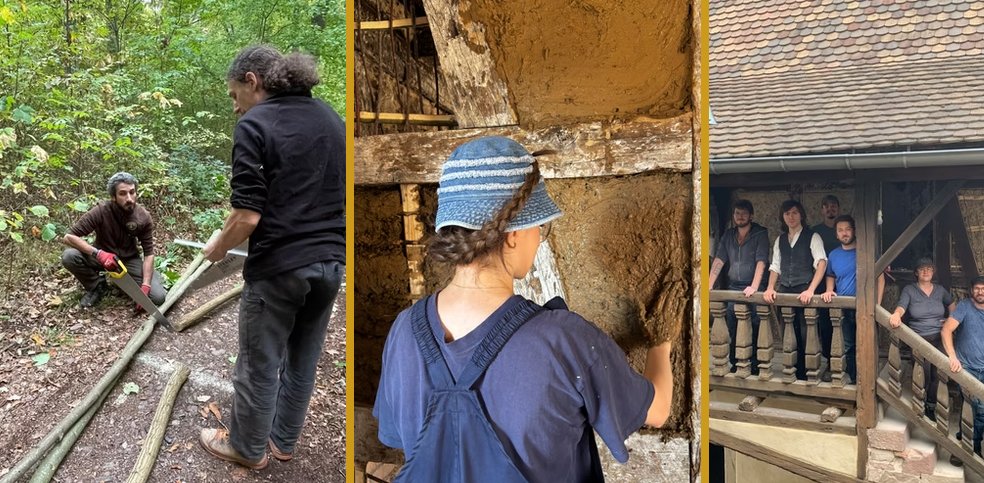
From the forest to the building site: selecting timber in the forest of Westhoffen; cutting 8 cm-diameter wood with a hatchet or saw for the palançons (the primary structure of the wattle infill), as well as thumb-thick branches for the secondary structure
Splitting and preparing the wood: splitting timber with a froe to produce the palançons, then shaping them with a drawknife on a shaving horse (pieces approximately 2 cm thick, with bevelled edges)
Wattle work: installing the palançons and weaving branches between the timber-frame members
Cob infill: preparing earth and straw fibres, then applying the mixture to the timber-frame panels
Traditional floor infill (plancher à quenouilles): exploring a traditional floor construction technique using earth, straw and palançons
Natural insulation: working with lightweight earth-and-straw mixtures and building the secondary timber structure
Masonry: building walls with pink sandstone rubble, preparing lime mortars and repointing masonry joints
Plasters and renders: preparing, applying and finishing lime-and-sand renders and earth plasters
Visit: a visit to a traditional lime kiln at Chaux Boehm
Introduction to stone carving
Practical information
Dates: Monday 10 to Friday 14 May 2027, or Monday 19 to Friday 23 July 2027. Each week is an independent session of the same workshop.
Hours: 9 am – 5 pm, lunch break 12 – 1 pm
Location: 1 rue Westerend, 67310 Westhoffen, France
Languages: French and English
Minimum age: 16 (applicants under 18 must provide written consent from a legal guardian)
Maximum: 10 participants per session; places are limited
Fee: €1,075 per session
Included: 5 training days, 5 nights’ accommodation in a gîte (including the night before the workshop begins), lunches (sandwich and salad, vegetarian option available), drinks, fruit and biscuits throughout the day.
Not included but mandatory: accident insurance covering the workshop, safety shoes, protective gloves, safety goggles and appropriate work clothing. Participants without the required equipment will not be allowed to take part.
Scholarships: Partial scholarships may be awarded at the discretion of the TRA’s Education Committee, based on applicants’ motivation letters and supporting documents (e.g. proof of a university scholarship, proof of income, proof of enrolment at a school or a short letter explaining your financial situation). We also encourage applicants to seek funding in their own country by contacting their university, a government body, a regional authority or a foundation.
University credits: Students may contact their university directly to have this workshop recognised for academic credit. Once the process is under way, our team will be happy to provide the necessary documents (programme, number of hours and certificate of attendance).
How to apply
Send your application to contact@latablerondearchitecture.com with the subject line “Application Traditional Building Techniques 2027 – First name Last name”, including:
The week you would like to attend (May or July);
Your full name, postal address, phone number and date of birth;
Your status or profession (architecture student, architect, carpenter, stonemason, teacher…) and your school or company;
A motivation letter in English or French (1 page maximum, as a PDF). You may also attach drawings or photographs of your projects.
Application deadline: 1 March 2027. Only complete applications will be considered.
 LA TABLE RONDE DE L'ARCHITECTURE
 From 01/07/2027 to 26/07/2027