Open in new tab - Back to search results
library

Newsletter : Building on Tradition – European Heritage Days 2025

guèdelon

Category

Newsletters

Publication date

16/09/2025

Linked profiles

Every September, communities across Europe come together to celebrate European Heritage Days.

This year’s theme, Heritage and Architecture: Windows to the Past, Doors to the Future, highlights the richness of Europe’s built environment while marking the 50th anniversary of the 1975 European Architectural Heritage Year, a milestone that first placed architecture at the heart of cultural preservation.

In this edition we celebrate some of the many skilled craftspeople who play an integral role in shaping and preserving Europe’s rich architectural heritage. From reviving traditional woodworking techniques in Belgium to a team of master-builders restoring a French château using medieval knowledge, the protection of both Europe’s rich history and its future shows promise.

From stone to timber, every aspect of architecture carries a legacy of craftsmanship and creativity.​

France : Guédélon, reviving 13th-century crafts to shape the future

"The 13th century has a lot to teach us. They sourced almost all their building materials within a radius of 15 to 20 kilometers. That meant lower costs, greater efficiency, and, in fact, more local work that also involved the community which is a good thing."

In the heart of Guédelon forest, in an abandoned quarry, a team of master-builders is building a 13th-century castle from scratch. Quarrymen, stonemasons, carpenter-joiners, woodcutters, blacksmiths, tilers, carters and rope makers are working together to revive heritage craft skills and to shed light on the world of medieval construction.

Italy: Young builders give a future to vernacular heritage at Cascina Bredalunga

"The art of making, of building, and also of rebuilding remains vitally important today: it is what preserves the extraordinary architectural and cultural heritage of our land."

Bredalunga

La Cascina Bredalunga, once home to nearly 200 people, lay abandoned for half a century. Now siblings Matteo and Letizia, with their parents Paola and Felice, are bringing it back to life. 

Norway: Ylva Seierstad’s visions for the future

Norwegian architecture graduate Ylva Seierstad felt that classical traditions were undervalued in modern education, often dismissed as outdated.
She disagreed, believing they still hold valuable lessons, on sustainability, diversity, and design, that can serve as contemporary tools for the future.

Belgium: Timber framing with Jordy Pattar

Belgian timber framer Jordy Pattar gives you a peak into keeping centuries-old building methods alive, shaping hand-hewn beams with wooden joints instead of nails and screws. His work reflects a passion for craftsmanship that links today’s builders with Belgium’s rich architectural medieval heritage.

Romania: Keeping the art of pargetting alive with Georgia Cristea

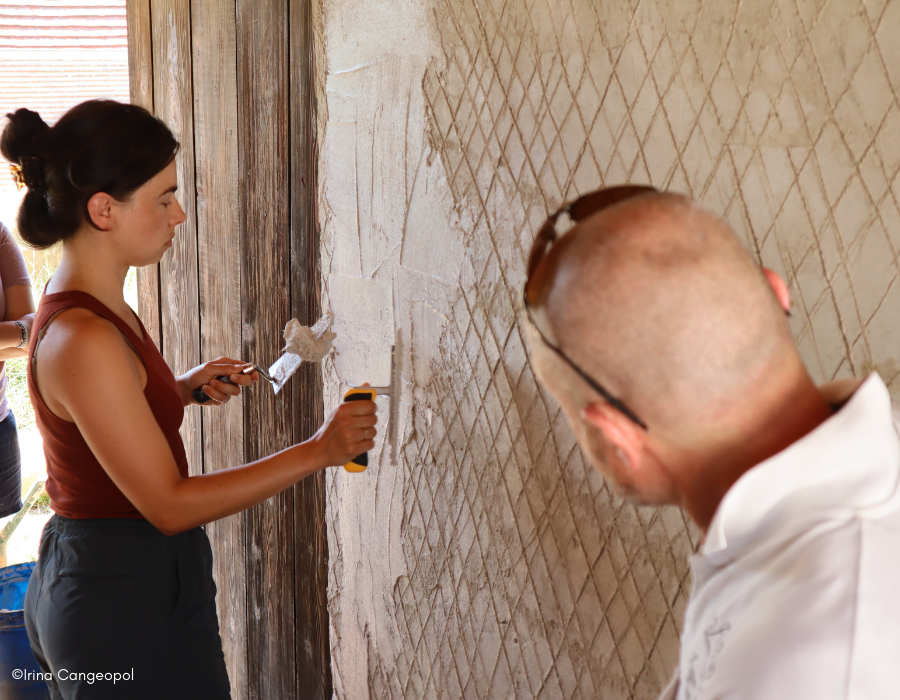
In August, INTBAU Romania and Bunesti School hosted a workshop on the traditional craft of pargetting, led by British artist James Collier with the support of INTBAU UK and INTBAU Belgium. Once popular in Romania from the late 17th century but now largely forgotten, pargetting is also listed in the UK as an endangered heritage craft. 

Georgia Cristea, Conservation Architect (RIBA CA) and INTBAU Romania’s Education and Projects Manager, shares her experience and the importance of reviving this endangered craft.

Upcoming events in the world of Architectural Heritage

News from the Mad'in Europe Community​

La Table Ronde de l’Architecture : The fourth edition of the Bruges Summer School of Architecture and Craftsmanship took place at the beginning of August under the best of circumstances. The 17 students explored the streets of Bruges to discover the wonderful Bruges Gothic style. Coming from many countries with diverse architectural traditions, they spent two weeks learning about this brick architecture, in which every element has a function. The architecture and urban planning of Bruges tell the story of the needs of a commercial city that opened up waterways, built market halls, places and a belfry, paved its streets and welcomed the whole world within its walls. By studying its architecture, students learned about its history.

Mad’in Europe took part in the third and final study visit of the BRICKS project, held in Florence from 10 to 12 September 2025. The visit focused on deepening our shared understanding of non-formal education in the craft sector, with the aim of shaping a final roadmap and set of policy recommendations to ensure its long-term sustainability.

Participants visited the rich craft ecosystem of Montelupo Fiorentino, attended the Artigianato e Palazzo fair, and engaged in presentations and exchanges with delegates from Georgia, Poland, Belgium, and Italy.

Madina Benvenuti, Director(MIE), presented the project and its objectives and current findings in a public forum at the Bricks Conference on the 12th of September at the Artigianato e Palazzo Fair.

Key questions remain at the heart of the discussion:

How do we certify learners and educators in non-formal settings?

What role can tools like digital badges play in this process?

While challenges persist, promising approaches are emerging. The BRICKS project continues to explore these pathways, seeking practical solutions to strengthen non-formal craft education across Europe.

In early September, the Mad’in Europe team attended the European Crafts Alliance Annual Conference 2025: Positioning Crafts in the Contemporary Economy in Oslo. During the GA, Mad’in Europe presented the CRAFTOUR initiative to attendees, explaining its mission to revitalise and safeguard European crafts. Afterwards, a series of thought provoking talks were held by various speakers on the topic of what being a crafts professional looks like in today’s economy.

On 11–12 September, the ARCHE project (Alliance for Research on Cultural Heritage in Europe) held its final event in Brussels, organised by the Fondation des Sciences du Patrimoine, the Flanders Heritage Agency, and KEA European Affairs. The two-day conference marked three years of Horizon Europe-funded work to strengthen the structuring and coordination of cultural heritage research across Europe.

Mad’in Europe joined on day one, where Isabelle Pallot-Frossard, President of the Foundation for Heritage Science, opened with a reminder: “We do not inherit from our ancestors, but borrow from our children.”

Key sessions explored the role of heritage science and humanities in building resilient communities, sustainable cities, and innovative partnerships across initiatives like IRIS, JPI, ECHOES, and the ARCHE Alliance.

European voices included Georg Häusler (DG EAC) on cultural heritage and climate change, Pilar Aguar Fernández (DG RTD) on the links between heritage, health, and society, and Pascal Lievaux (JPI Cultural Heritage) on aligning research at national and EU levels.
National examples, from Slovakia’s heritage skills training to the Time Machine Organisation’s digital initiatives, showcased innovation in action.

The event confirmed one key message: researchers must be involved from the very beginning of policy-making to ensure cultural heritage remains resilient and future-oriented.

Resource Centre

By valuing these traditions, we reconnect with Europe’s cultural past while safeguarding knowledge and skills for the generations to come. Explore more events your country has to offer for

European Heritage days 2025 

Related resources

CRAFTOUR

CRAFTOUR: Bringing crafts to the European Union Agenda

CRAFTOUR : 75 partners, 21 countries, one vision CRAFTOUR is a European initiative, coordinated by…
paper

Newsletter: The versatility of paper

Paper is a material we encounter every day, yet its cultural depth and creative potential…

Newsletter: What did we build together in 2025?

2025! A rich and exciting year for Mad’in Europe Once again, our small team has…

Newsletter: 100% WOOL

100% wool? A memory or a reality? In this newsletter, we explore the wonderful world…

Invite a friend